In the current data-driven world, businesses are in a sea of unconnected data. Regardless of all the information available, the challenge of accessing real value is still a significant challenge. What happens when you have a means to disintegrate these silos without having to replicate information and strain your systems? Zero Copy Integration of Salesforce Data Cloud.
The absence of a powerful data integration solution can make businesses ineffective, slow, and faulty due to the use of independent data sources. The traditional approaches that include the generation of several copies of the data only contribute to the aggravation of these problems by causing unnecessary storage expenses and inconsistency of the information across platforms.
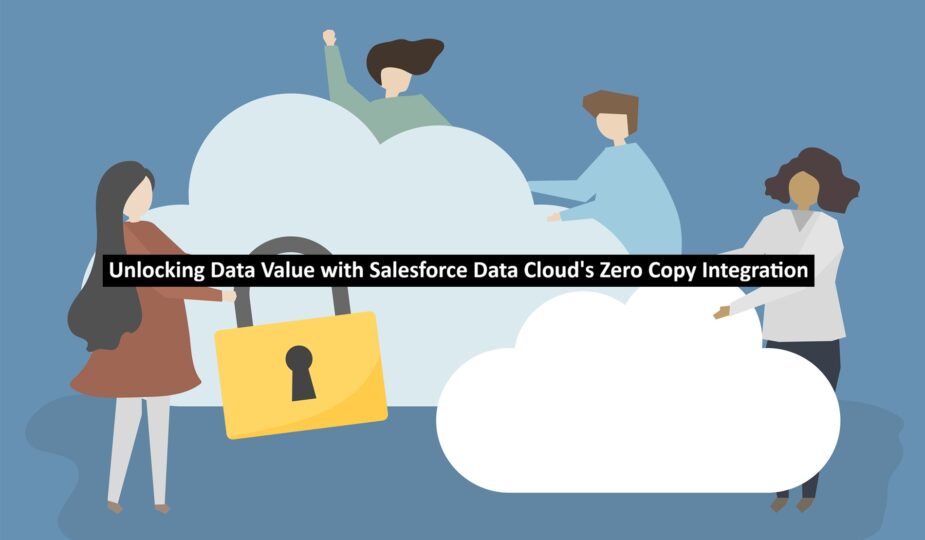
The Zero Copy Integration on Salesforce Data Cloud offers a new solution to such problems. It enables companies to shred the data silos and be able to share information across platforms in real-time, without making duplicate records or running into outdated data. Businesses can use this to leverage the full potential of their data by putting aside the complexities and inefficiencies of the old ways of integrating.

What is Salesforce Data Cloud Zero Copy Integration?
- Zero Copy Integration is a data-sharing method that allows businesses to access and share information on various platforms without producing new copies of the data.
- This is done to make sure that the businesses are not exposed to the general challenges of data duplication, which include high storage expenses, data discrepancies, and delays in making decisions.
How It Works:
- The Salesforce Data Cloud has an exclusive architecture that manages to provide real-time data without the necessity of creating copies.
- The integration enables real-time access to data in different systems, applications, and analytics platforms through a single system that means that the latest data is available whenever needed to plan.
Read: What Is Business Process Automation? 9 Real-World Applications
Introduction to Zero Copy Integration with Salesforce Data Cloud.
Implementation Tips:
- A successful execution of Zero Copy Integration requires that the businesses must initially review their data architecture to ascertain whether the architecture can support real-time access of data.
- An integration with a partner who is also Salesforce-certified may facilitate the process of integration and make sure that your organization is ready to share data without any issues.
- The businesses are also supposed to make sure that the IT infrastructure is configured to manage real-time data flow, and appropriate security measures are also in place.
Key Considerations:
- Data governance policies should be examined by businesses before integration. The compliance requirements, data privacy, and data security are to be ensured.
- By matching your data management plans in an organization with the potential of Salesforce Data Cloud, it is ensured that sensitive information is kept safe, and that data can still be shared effectively and efficiently.
Advantages of Zero Copies Integration in Salesforce Data Cloud.
Cost-Efficiency and Optimization of storage:
- Among the greatest benefits of Zero Copy Integration, it is possible to name the decreased costs of storage.
- By removing the data duplication process, business saves the storage infrastructure, and the cost of overall operations is lower.
- The net effect of such optimization is the resource utilization and cost saving that can be diverted to other sections of the business.
Better Data Consistency and Accuracy:
- Zero Copy Integration is used to ensure consistency of data. With a single source of truth, one can ensure that only the latest information is available to all departments.
- This will reduce the possibility of errors and inbuilt inconsistency, which would be expected that using an old or varied copy of the data.
Real-Time Data Access:
- Zero Copy Integration gives businesses the power to make better decisions in a shorter period of time.
- By facilitating real-time access to data on different platforms, businesses will be able to respond to the needs of the customers and market fluctuations at any particular time.
- Such agility can lead to competitive advantage where the firms can use opportunities and address issues as they come.
Major Characteristics of Zero Copy Integration at Salesforce Data Cloud.
Information Interconnectedness and Smooth Integration:
- Zero Copy Integration helps to move data between Salesforce and the outside system seamlessly without requiring the repetition of data.
- Regardless of whether it is connected to the ERP, cloud systems such as Amazon Redshift or other third-party analytics software, the integration will help ensure that data is always available to be analyzed to help businesses unlock insights within their entire technology portfolio.
Improved Data Control and Protection:
- Salesforce Data Cloud provides strong data control and security. Under Zero Copy Integration, the sharing of data follows rigorous governance policies that observe the privacy rules and even the company policies.
- Traceable access and audit logs have advantages in that organizations can always guarantee data security and share it easily across the platforms.
Scalability and Flexibility:
- As companies expand, so does the volume of information that they produce. The Zero Copy Integration of Salesforce Data Cloud can be scaled, which means that a company is capable of handling the growing data volumes without compromising the performance.
- The integration is flexible and compliant to the needs of both small startups and large business organizations to adapt to the changing business requirements.
Integration with Other Platforms (Emphasis on Compatibility)
Cross-Platform Benefits:
- Among the most striking features of Salesforce Data Cloud Zero Copy Integration, one can mention the possibility to integrate it with other platforms, including Amazon Redshift, where businesses can attain unified analytics.
- With the integration of other cloud solutions and third-party systems, businesses can combine data from various sources and analyze it in a unifying environment.
Examples of Integration:
- The integration feature of Salesforce Data Cloud allows the business to exchange data within departments and platforms.
- To use an illustration, a company may combine CRM data provided by Salesforce with the inventory data provided by an ERP system to give a single perspective of sales and stock marriages.
- With this integration, businesses will be able to make informed decisions using real-time and in-depth information.
Conclusion
The Zero Copy Integration of Salesforce Data Cloud provides companies with an effective method to share data in the most efficient way, lower expenses, and increase real-time decision making. It removes duplication of data, which guarantees stable and high-quality data access to businesses across the platforms, enabling businesses to get the maximum out of their data.
The important thing to implement this integration successfully is to collaborate with the appropriate Salesforce service provider. A proficient partner will take you through the technicalities, and make sure you have a smooth integration and in tandem with your business objectives. Their proficiency could be utilized in maximizing your data architecture and in securing and complying.
In selecting someone to collaborate with in this integration, the areas that should be looked at are experience, understanding of the industry as well as his/her capability to offer continuous support. The partner of the right choice will not only provide seamless integration but also allow your organization to make use of the Salesforce Data Cloud capabilities in the long term to be a success story.
Author’s Bio:
Minuscule Technologies is your Salesforce engineering partner, not just a consultant. We solve today’s critical enterprise challenges by modernizing legacy systems, cutting technical debt, and implementing AI-powered DevOps.