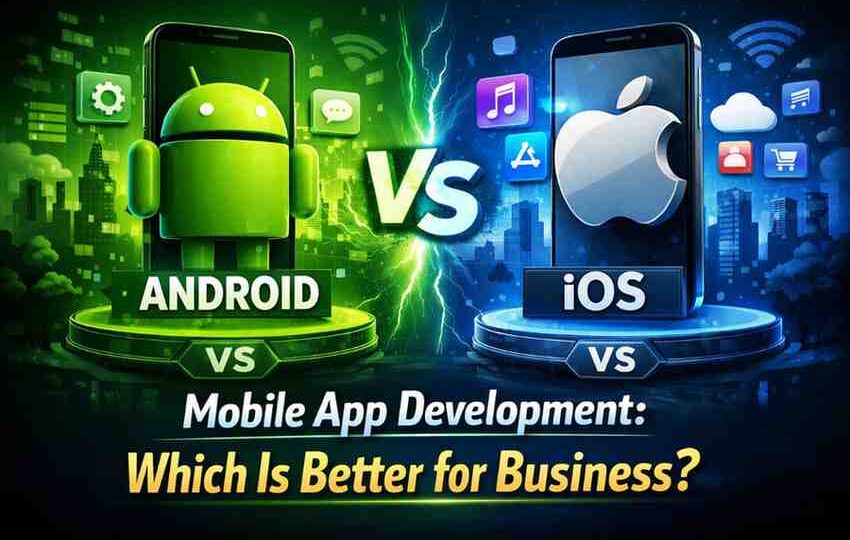
This question usually shows up earlier than it should. Sometimes, before the business model is fully clear and well before the first customer interview. Android or iOS? Pick one. Most of the time, this question is treated as if a single decision will determine whether the app succeeds or quietly disappears within six months.
I have worked with many startups, small businesses, and mid-sized companies across different industries. And after developing mobile applications for them, I have come to believe the platform debate is useful, but only if you keep it grounded in business reality. Not ideology, not trends, and not what a competitor did three years ago.
There is no universally better platform. There is a platform that fits your business context better and another that will quietly work against you.
Platform Decisions are Rarely Technical
Founders often frame Android vs. iOS as a tech stack discussion. Open ecosystem versus closed? Kotlin versus Swift? Fragmentation versus control?
Well, practically, selecting a platform is a matter of product distribution, speed of iteration, and how much friction your business can afford at the start.
For example, if your app is relying on getting feedback very quickly, doing frequent updates, and changing the pricing or onboarding to attract customers, then that decision will outweigh the importance of a perfectly structured codebase.
And, if your business relies on reach, especially across varied demographics, that matters more than theoretical engagement metrics.
I have seen teams over-optimize for the “right” platform and under-optimize for the right customer.
Read: How Workspaces Are Adapting to the Needs of Modern Workers
Android: Where Scale Wins
Android’s biggest advantage is simple: it’s everywhere, leading the market with nearly 72% share.
In several countries, Android is winning the market not because the users philosophically prefer it, but because it is cheap, flexible, and simply what people already have in their pockets. This holds regardless of whether you are developing a retail loyalty app, a healthcare booking system, an internal enterprise tool, or a consumer-facing app such as food delivery or ride-hailing.
Such is one of the reasons why a mobile app development company in India would generally gently persuade their clients to go Android first, in particular for those businesses aiming at mass adoption. The potential market is bigger, and there is less of a barrier to entry for the users.
The trade-off is complexity. Device fragmentation is real. OS versions vary. Performance can be inconsistent. You spend more time testing edge cases and handling unexpected behavior.
But Android is better in its own ways, like the app approvals are faster, and deployment is more flexible. You can experiment without feeling like every update is a high-stakes event. For businesses that need to move quickly or adjust features based on real usage, that flexibility matters.
iOS: Discipline Over Chaos
iOS development feels more contained, with the advantage of fewer device types, which brings more predictable performance and cleaner design expectations.
For some businesses, iOS consistency is a big plus. Apps for premium users, subscription apps, or carefully planned workflows often do better. Analytics are cleaner UX choices that last longer, and there is less chaos to manage
But iOS comes with its own friction. Apple’s review process is strict, sometimes opaque, and rarely sympathetic to startups under pressure. Updates can be delayed for reasons that feel trivial when you’re racing against timelines.
iOS users also expect a higher level of refinement. Launching something rough around the edges is less acceptable here. That’s not good or bad. It’s just reality.
For teams with limited resources, this expectation gap can stretch timelines and budgets if it’s not accounted for early.
Budget Often Makes the Call
Platform discussions eventually circle back to budget, even if no one says it outright.
Building two fully native apps is expensive. Not just initially, but over time. Maintenance, feature parity, bug fixes, and OS updates. It adds up.
This is where many businesses explore cross-platform development. The motivation is rarely trend-driven. It’s survival-driven.
Choosing to hire React Native app developers can be kind of a strategic decision. A single codebase not only speeds up the development process but also makes it easier to maintain feature parity across platforms. In fact, the performance level is good and adequate for most business scenarios.
Frameworks such as React Native, Flutter, and other similar tools are now capable of handling a wide range of applications. Besides e-commerce platforms, booking systems, and content-based apps, more complex solutions like fintech dashboards or logistics tools can be developed just as efficiently with a few native extensions.
Going cross-platform, startups can run at a great pace, check their ideas on the market, and reach more than one audience without their development efforts being doubled. What it basically does is offer you the freedom, the quickness, and the effectiveness to get your ideas into the market faster and seize the chances earlier.
User Behavior Over Tech Philosophy
One pattern shows up repeatedly. Businesses targeting early adopters and investors lean toward iOS. Businesses targeting broad usage and operational scale lean toward Android.
This is about context and not quality.
If your users are urban professionals, design-sensitive, and already deep in the Apple ecosystem, iOS app development makes sense. Conversion rates can be higher. Support overhead can be lower.
If your users span income levels, geographies, or job roles, Android often reflects reality more accurately. That includes industries like education, retail, healthcare access, logistics, field services, and yes, even taxi booking apps alongside food delivery or home services.
The mistake is assuming one audience behaves like another.
Lessons Beyond Your Industry
A fitness startup targeting premium subscriptions may benefit from launching on iOS first.
A regional e-learning platform might find Android indispensable.
A B2B SaaS companion app may prioritize iOS for executive users, while an operations app might live primarily on Android devices.
Even within the same company, different apps may justify different platform strategies.
A taxi booking app development company, for instance, usually creates passenger apps for both operating systems. However, they might notice higher early traction on Android in several markets, whereas iOS users may demonstrate stronger retention or higher spending. That same pattern is evident in grocery delivery, on-demand services, and marketplace apps.
The platform choice doesn’t define the business. It supports how the business actually operates.
Regulation, updates, and operational friction
Some businesses underestimate how platform rules affect operations.
iOS enforces strict policies on payments, data usage, and background processes. In some cases, especially the ones involving subscriptions or digital goods, the Apple ecosystem presents limitations that have to be taken into account and worked around from the very first day.
Android offers more leeway, but that flexibility can become technical debt if abused.
Neither platform is “easier” in a universal sense. They simply punish different mistakes.
Android punishes lack of testing and performance discipline.
iOS punishes shortcuts and ambiguity.
Understanding which punishment you’re more equipped to handle is part of making a smart decision.
Investors, optics, and reality
It may not be easy to admit, but impression counts. Some investors still associate iOS with product maturity and Android with reach. In fact, it is quite an oversimplification of the matter, but it still can affect business talks.
The danger is letting optics override fundamentals. Launching on a platform your customers don’t use just to signal polish is rarely a winning move.
The stronger position is being able to explain why you chose a platform and how it aligns with growth, cost control, and user behavior. That clarity matters more than the logo on the app store.
Conclusion
Platform choice does not guarantee success or failure. A well-designed business can succeed on any platform, while a weak model will need more than technology to succeed.
The smartest teams treat Android vs iOS as a sequencing decision, not a permanent identity. Start where your users are, then learn. Expand when it makes sense.
If that means Android-first, fine. If it means iOS-first, also fine. If it means cross-platform to buy time and flexibility, that’s often the most honest option.
The error is in treating the choice as a philosophical stance rather than a business tool. Work with an experienced Indiaappdeveloper to pick the platform that allows you to learn fastest, serve users effectively, and adapt over time.
Author’s Bio:
I’m Krunal Vyas, an IT consultant at IndiaAppDeveloper, one of the leading Mobile App and Software Development Companies in India. I have helped more than 300+ clients to bring ideas into reality.