Introduction
The modern day rapid diagnostic world has placed the laboratory in a continuous stress to provide speed, accuracy, and regulatory conformity. Increased volumes of tests, patient expectations and high-quality healthcare standards require effective laboratory functioning. A Laboratory Information Management System allows automation and traceability as well as quality control. The additional workflows of a laboratory information management system, combined with Pathology Lab Software and Laboratory Billing Software, are a good example of how the LIMS come into play in healthcare improving the diagnostics, governance, and outcomes of a single lab management information system.
Workflows in Including LIMS Processing Accession-Based LIMS
Processing in Accession-Based LIMS Workflows
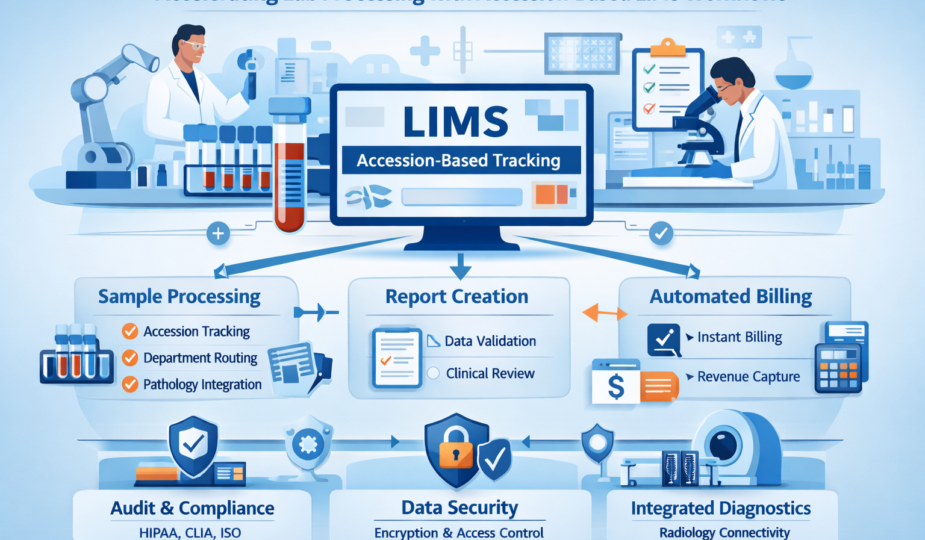
Laboratory works are largely supported by processing and a Laboratory Information Management System is specifically tailored to maximize this process through accession-based workflows. In a modern laboratory information management system, every sample will have a unique accession number when it is received. This accession number would form the digital identity of the sample and accompany the sample to all stages of laboratory work, such as testing, reporting, approval, and billing.
Sample Identification and Tracking: by Accession
The accession-based processing of a LIMS laboratory information management system will greatly decrease the number of manual operations and the errors typical of the manual system, including mislabeling or duplication of samples. The lab management information system provides a system where every sample can be traced in real-time to enhance accountability and transparency within the laboratory.
The main benefits of tracking are:
- Each sample has a unique accession number.
- Lifecycle testing end to end visibility.
- Less use of manual documentation.
The characteristics outline the advantages of the adoption of laboratory information management systems in the complicated diagnostic processes.
Departmental Sample Routing Automation
The Laboratory Information Management System automatically directs the samples to the correct departments thus maintaining workflow within the system. Biochemistry, microbiology, hematology, histopathology, and radiology are some of the other departments that are managed in the same digital ecosystem.
This automation enables:
- Movement of samples across the departments is faster.
- Improved communication between laboratory teams.
- Better workload allocation and visibility.
Through such streamlined routing, it is clear how LIMS are used in healthcare in enhancing operational efficiency by having a centralized lab management information system.
Pathology and Billing Systems Integration
The efficiency of processing is also enhanced upon incorporation of Pathology Lab Software into the Laboratory Information Management System. Pathologists will be able to obtain the status of samples in real-time, consult past records, and compare clinical data without any delays.
Simultaneously, Laboratory Billing Software provides that:
- All processed tests are automatically recorded.
- Billing records are created correctly.
- Leakage in revenues is reduced.
These combined workflows describe how the LIMS are involved in healthcare, connecting diagnostics to operational and financial sustainability and strengthen the advantages of the implementation of laboratory information management systems.
Read: How Modern Plastic Surgery is Redefining Wellness
Creation of Reports with Accession-Based LIMS
Application of Laboratory Information Management System in Making Reports
One of the most important products of laboratory processing is report creation, and a Laboratory Information Management System is one of the key factors that guarantee its quality and timeliness as well as regulatory compliance. The laboratory information management system accession-based workflows will make sure that all test results are always associated with the appropriate patient, physician and diagnostic request.
Automated Data Capture and Data Validation
LIMS laboratory information management system gathers laboratory results directly out of laboratory analyzers and diagnostic equipment, therefore, avoiding manual data entry. Results are compared with built-in reference ranges in automated validation rules and then compared to generate reports.
Pathology-Driven Reporting and Built In Pathology Lab Software
Connection to Pathology Lab Software enhances the report writing by providing elaborate pathology reporting. Laboratory Information Management System enables the pathology personnel to incorporate detailed histopathology, cytology, and molecular diagnostic accounts with formal report templates.
Laboratory Billing Software Financial Alignment
Laboratory Billing Software makes both diagnostic reports and financial records to be in total synchronization. With reports being prepared in the laboratory information management system, the billing records are automatically made with the proper use of billing codes and reimbursement regulations.
Accession-Based LIMS Workflows Approval Method
Approach of LIMS Workflow Accession
Value of Laboratory Information Management System in Approvals
Laboratory operations are incomplete without approval workflows which promote accuracy, quality assurance and the compliance with the regulations. In an information management system within the laboratory, this method is facilitated through accession-based workflows which assign unique identities to each sample and reports. All the reports pass through a standardized approval procedure, which enables technical employees and the pathologists to confirm the results before discharge. The strategy helps to remove errors, unfinished or poorly handled reports, and standardized review of all parts of the laboratory. The lab management information system also ensures full transparency by monitoring the report status using the accession number, thus allowing the laboratories to be responsible and operate more efficiently.
Pathology Lab Software Clinical Validation
The implementation of Pathology Lab Software into the LIMS laboratory information management system will make sure that all diagnostic reports are obtained through rigorous clinical validation. Results may be reviewed and authenticated by senior pathologists and authorized staff and compared with historical patient data and correlated clinical outcomes. Uniform report templates improve uniformity in how it is interpreted and lowers the chances of diagnostic errors. Immediate data and past tests can enable pathologists to make critical decisions fast and enhance the handling of the patients and the accuracy of the diagnosis. This is the way that LIMS can be used in healthcare, improving the accuracy and communication via a centralized lab management information system.
Laboratory Billing Software Automated Billing
Reports that are approved automatically activate Laboratory Billing Software to create billing entries of the completed diagnostic services. This integration will remove the need to manually intervene with the billing, lower the errors, and capture the revenues on time. The Laboratory Information Management System creates alignment between clinical approvals and billing procedures and harmonizes test outcomes with the right code and payment rates. Such a smooth coordination does not only enhance operational efficiency but shows how LIMS can be used in healthcare to bridge the gap between diagnostics and financial management and operational sustainability.
Information System Integration Radiology
Integration of Diagnostics By Accession
Plugging in radiology will significantly enhance the quality of diagnosis of a Laboratory Information Management System through the establishment of a shared diagnostic environment.
The main benefits of accession-based integration are unified radiology and lab systems, reduced duplication of diagnostic records, and enhanced traceability of image and pathology records.
Diagnostic Systems have predictable information exchange
The LIMS laboratory information management system also enhances the effective flow of data through the radiology systems, Pathology Lab Software and the core lab departments. By integrating imaging and pathology, this technology allows quicker access to integrated imaging and pathology data, improved diagnostic relationships, enhanced clinical confidence, and minimized time loss during manual reconciliation.
Determining Data Security on Accession-Based LIMS Workflows
Information Management System Laboratory Security Foundation
One of the fundamental requirements of any Laboratory Information Management System deployed in modern healthcare facilities is data security. The laboratory information management system has accession-based transactions to make sure that each sample, report and transaction is assigned a unique identifier through which its lifecycle can be traced and controlled. The system limits unauthorized access and enhances accountability and so at no time are sensitive patient and diagnostic information compromised.
Permissions and Role Access Control
Laboratory Information Management System is developed in a way that role-based access control permits a user to access, manipulate or approve data only up to the extent of his responsibilities. Every technician, pathologist, administrator and billing personnel will have different permissions and confidential information is less exposed. Access and modifications are closely supervised to ensure the safety of clinical and financial information and to comply with the regulations.
Coding and Data Confidentiality
LIMS laboratory information management system has the use of state-of-the-art encryption measures to encrypt data at rest and in transit. The clinical information that will be through the Pathology Lab Software is encrypted to avoid unauthorized exposure and the financial and insurance related information that will be through the Laboratory Billing Software is secure as well. These ciphers’ workflow guarantee that diagnostic and administrative data are encrypted and guarded throughout the laboratory ecosystem.
Conclusion
The revolution in the manner in which the laboratories are going to be run within the healthcare ecosystems can be attributed to workflows of accession that have been driven by a Laboratory Information Management System. The combination of the Pathology Lab Software, Laboratory Billing Software and radiology systems makes laboratories more efficient, precise and compliant. These information workflows show the role of LIMS in healthcare, including diagnostics, through revenue management. An effectively built lab management information system will make the system scalable, ensure the safety of the data and long-term operational success as it will bring enduring benefits to the implementation of laboratory information management systems.
Author’s Bio:
Hi, I’m Parth Makvana, and I work in SEO at Healthray Technologies Pvt. Ltd. I help improve our online visibility while supporting awareness of Healthray products — including Hospital Information Management System (HIMS), and enhance patient care.